
Canvas
Night Poet
Preface
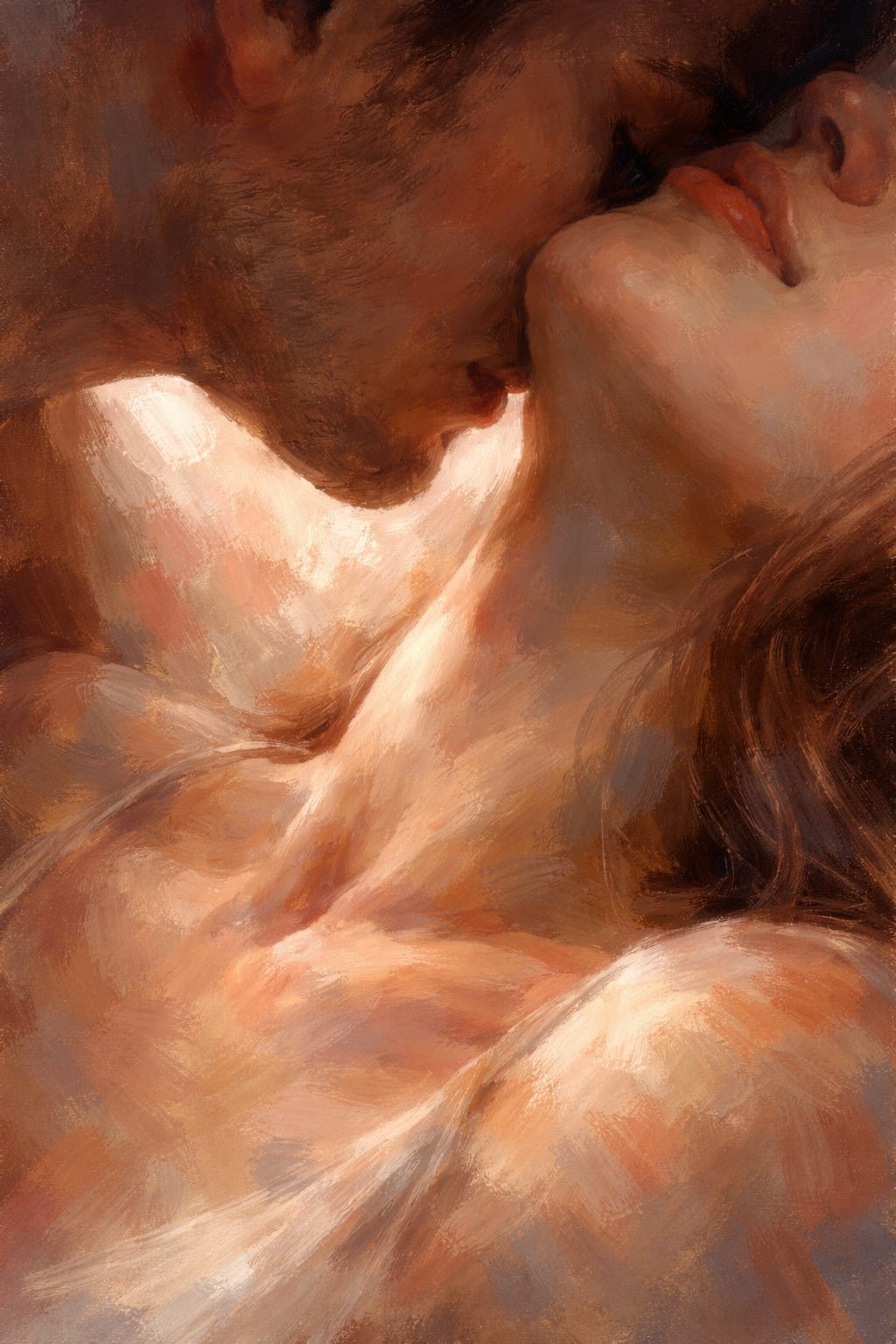
This poem arises from a belief in intimacy as a shared place. What draws me is the quieter space where two people choose to remain present to one another. Canvas moves within that exchange, attentive to how desire stays awake to what it touches. Here, touch is not an act of taking but a conversation between surfaces, nerves, and will, a form of listening. Desire is shaped between two lives, held in the mutual risk of being altered.
.
I reach for your skin—
hands learning
the curve,
the ridge of bone
where muscle softens like clay.
You draw back a breath,
and my touch shifts,
finding its place not over you
but against—
palm to grain,
as if I am feeling the weave
beneath the gesso.

Lips place warmth
into shadow,
slow as pigment into canvas.
Your breath tilts the light,
shaping how colour settles,
which strokes hold,
which are allowed to fade.

My tongue—
the brush’s edge—
does not glide.
It catches on what you have left rough,
draws through the grain you offer,
where meaning pools like glaze
only if we let it settle.

You are not the painting.
We are
lines that waver as we move,
hues that resist before they blend,
a surface altered
by every measured press.

Hands move inward,
but you redirect them
to knotted muscle,
to the pulse that answers
only when you allow it.
What I thought I knew
about you
loosens in my hands—
and I feel the small fear
of being changed
by what I touch.

Lips find
the seam between warmth and cool,
where shadow holds.
You tilt your head,
present new skin,
paint over what I laid down
with something thick as impasto—
neither of us could make
alone.

The brush pauses
at the edge of the frame.
We lean in, then away—
unsure where it ends,
unwilling to mend
what is still becoming.

You hold,
then change by your own will.
A curve deepens.
A line tightens with breath.
The gesture refuses to settle—
holding its shape
as it shifts.

What remains
is not the image
but the ache of staying,
the risk of being seen
in the meeting of thumb to skin—
the way every stroke
scrubs clean
who I was
to ask who I am
now.


.
Thank you for reading with the kind of attention this poem asks for. If it has done its work, you will have felt less like a spectator and more like a participant, which is all I ever hoped for.
—L. O. Campbell
The poem feels like two people learning each other with their whole bodies, adjusting in real time to every breath and hesitation.
It shows how true intimacy isn’t about taking but about listening with the skin, letting touch become a conversation.
Every gesture carries vulnerability a willingness to be changed by what the other reveals or withholds.
The imagery of canvas, pigment, and grain turns desire into something slow, textured, and deeply attentive.
The poem refuses the idea of one person shaping the other; instead, the relationship becomes the shifting artwork they make together.
There is a quiet fear beneath the tenderness the fear of losing the self while reaching toward another.
Moments of withdrawal and offering become part of the composition, marks that move and blur with each shared breath.
Intimacy appears as a space where both bodies risk being seen without defence, without certainty.
The poem honours the unfinished, the way closeness resists being fixed or defined too quickly.
What lingers is the ache of mutual presence the knowledge that every touch asks who you are now, and who you are willing to become in the other’s hands.
This feels deeply attentive – not just to touch, but to consent, mutual shaping, and the quiet risk of being changed by another. What stayed with me was how desire listens rather than takes, and how the imagery returns to presence rather than possession. A very carefully held piece. 🌿